Friday, July 20, 2007

Happiness


A 102 year-old, petite, well-poised and proud man, who is fully dressed each morning by eight o'clock, with his hair fashionably coifed and shaved perfectly applied, even though he is legally blind, moved to a nursing home today. His wife of 70 years recently passed away, making the move necessary. After many hours of waiting patiently in the lobby of the nursing home, he smiled sweetly when told his room was ready.

As he maneuvered his walker to the elevator, I provided a visual description of his tiny room, including the eyelet sheets that had been hung on his window.

"I love it," he stated with the enthusiasm of an eight-year-old having just been presented with a new puppy.

"Mr. Jones, you haven't seen the room; just wait."

"That doesn't have anything to do with it," he replied.

"Happiness is something you decide on ahead of time. Whether I like my room or not doesn't depend on how the furniture is arranged ... it's how I arrange my mind. I already decided to love it. It's a decision I make every morning when I wake up. I have a choice; I can spend the day in bed recounting the difficulty I have with the parts of my body that no longer work, or get out of bed and be thankful for the ones that do.

Each day is a gift, and as long as my eyes open I'll focus on the new day and all the happy memories I've stored away. Just for this time in my life.

Old age is like a bank account. You withdraw from what you've put in.

So, my advice to you would be to deposit a lot of happiness in the bank account of memories. Thank you for your part in filling my Memory bank. I am still depositing."

Remember the five simple rules to be happy:

1. Free your heart from hatred.

2. Free your mind from worries.

3. Live simply.

4. Give more.

5. Expect less.

Thursday, July 19, 2007

Why "Pretty Good" Isn't Good Enough

Here is one of my favorite pieces from the man
who every week says, "See you on the radio".

WHY "PRETTY GOOD" ISN'T GOOD ENOUGH

There once was a pretty good student,
Who sat in a pretty good class,
And was taught by a pretty good teacher,
Who always let pretty good pass.

He wasn't terrific at reading,
He wasn't a whiz-bang at math,
But for him education was leading,
Straight down a pretty good path.

He didn't find school too exciting,

But he wanted to do pretty well,
And he did have some trouble with writing,
And nobody had taught him to spell.

When doing arithmetic problems,
Pretty good was regarded as fine,
Five plus five needn't always add up to be 10,
A pretty good answer was nine.

The pretty good class that he sat in,
Was part of a pretty good school,
And the student was not an exception,
On the contrary, he was the rule.

The pretty good school that he went to,
Was there in a pretty good town,
And nobody there seemed to notice,
He could not tell a verb from a noun.

The pretty good student in fact was,
Part of a pretty good mob,

And the first time he knew what he lacked was,
Whe he looked for a pretty good job.

It was then, when he sought a position,
He discovered that life could be tough,
And he soon had a sneaky suspicion,
Pretty good might not be good enough.

The pretty good town in our story,
Was part of a pretty good state,
Which had pretty good aspirations,
And prayed for a pretty good fate.

There once was a pretty good nation,
Pretty proud of the greatness it had,
Which learned much too late,
If you wanto be great,
Pretty good is, in fact, pretty bad.

"Osgood File"

Tuesday, July 03, 2007

Writing Workshop - Newspaper Report


Use this frame to structure your newspaper article report.


Newspaper report frame


Name of newspaper:

Headline:

Writer:

Date of Publication:

Complete these starters:

This article was about...

An interesting fact I learned was ...

In addition to this, I learned that ...

In my opinion, ...


To share your newspaper report - click on Comments and type in your newspaper report.

Monday, July 02, 2007

Writing Poetry - a diamante


A diamante is a symmetrical poem. A diamantecan be structured like this:

Line 1: a noun
Line 2: two adjectives associated with line 1
Line 3: three participles associated with line 1
Line 4: two words associated with line 1; two words associated with line 7; a semi-colon separating the groups
Line 5: three participles associated with line 7
Line 6: two adjectives associated with line 7
Line 7: a noun that's an antonym of line 1.

Here's a diamante by a fifth-grader.

Rain
white, wet
sprinkling, splashing, dancing
umbrellas, clouds; shorts, shirts
playing, running, swimming
gold, hot
sun


Now write your symmetrical poem.

To share your work - click on Comments and type in your poem.

Sunday, July 01, 2007

Writing Workshop - A Story


Maya Angelou


Let’s Write a Story


How to Get an Idea


1. Collect four or more ideas that you could write a story about. Make a chart. Write each idea on the left-hand side of the chart and tell where it came from on the right-hand side of the chart.

2. Pick the idea from your list that you like best. Put a check in front of it. this is the idea you will turn into a story.


How to Plot Your Story


1. Write the big question readers will want answered by the end of your story. This question should be about your main character's big problem.

What will your character be able to at the conclusion of your story?

2. List at least three smaller questions people will guess about as they
read your story.

3. Now make a plot outline that lists the parts of the story. Write it on a sheet.


How to Invent Characters


1. Create a character chart, list each character. The first might a hero or a villain. Tell who each of the other characters are — perhaps the hero's friend, the villain's helper, the victim, a bystander, a foolish person, or whoever.

2. Give the details about each character by completing the chart. Details might include male or female, age, height, weight, eye color, hair color and length. Other Details - friends, hobbies, habits, and so on.


How to Invent Settings


1. In a setting chart, list each place where something happens in your story.

2. In a sentence, tell what happens in that place.

3. List the important details about the place: Is it big, small, light, dark, hot, cold, wet, dry, soft. hard. empty, filled with things, or what?
(Remember: You don't have to make up every place in your head. You can use real places from your life or take details from pictures.)


How to Gather Facts for a Story


1. In a fact chart, write the questions you'll need to answer before
you write your story.

2. After each question, tell how you will find the answer. List the name of
a book, a person, or a place where you plan to look. If you think you
already know the answer, make sure you're right.

3. On a sheet, write the answers you find for each question.


How to Write a First Draft


1. Prepare your writing space.
• Have several sharp pencils.
• Have plenty of lined paper.
• Have your outline handy.

2. Think about the scene you're going to write about. Try to see the action
and characters in your mind. Draw your scenes on paper.

3. As you write, skip every other line.

4. Let your ideas flow. Circle any words or punctuation marks that you
want to check later.

5. If it helps you, speak the lines your characters will say.

6. From time to time, read over what you've written.

7. Put your first draft away for a while before you try to make it better.


How to Improve Your First Draft


1. Gather the materials you'll need — your first draft, some sharp pencils, and a dictionary.

2. Read your paper slowly. You might want to read it out loud.
• Make sure you have an interesting beginning and a real ending.
• Go over the action step by step. Be sure that no important scenes are missing or in the wrong order.
• See if your words make clear pictures. Add details if you need to.
• Read the dialogue (speeches) out loud. Make sure each tag shows who is speaking and how — for example, "Stop," I yelled.
• Look up the spelling of each word you're not sure of. Correct any mistakes you find.
• Check the way you've used capital letters and punctuation marks. Be sure they're right.

3. After you've checked your work, ask a friend to read your paper and give you tips for making it better.

To share your work - click on Comments and type in your story.

Saturday, June 30, 2007

Writing Workshop - O. Henry


O. Henry


O. Henry is the pen name of William Sydney Porter, one of America's most famous snort story writers. His mother died when he was three; his Father, a physician, became an alcoholic and worked continuously to invent a perpetual motion machine.

Porter left school at age fifteen and went to work in a drugstore. When he began to show symptoms of tuberculosis, he moved to Texas and worked on a ranch. He married and lived in Austin where he began a newspaper called "The Rolling Stone." It failed. He was accused of embezzling bank funds and fled to Honduras.

In 1887, Porter returned to the U.S. because his wife was dying. He was then put in a federal prison in Ohio. Released in 1901, he moved to New York City, where he lived and wrote for nine more years. Porter died a penniless alcoholic. No one knew that he was the famous 0. Henry, master of the ironic ending.


O. Henry begins his stories in interesting ways, and often ends them in even more interesting ways. On the screens below you will find the beginning lines from several of O. Henry's stories.

Read through each of the choices. Consider how to use the beginning to unfold your own story. Spend a few minutes just thinking about a story line. You might want to type a few notes on plot, setting, and character if they come to mind. After you've looked at all the choices, choose the one you like the most.

Choice #1

SPRINGTIME A LA CARTE

"It was a day in March.

Never, never begin a story this way when you write one. No opening could possibly be worse. It is unimaginative, flat, dry, and likely to consist of mere wind. But in this instance it is allowable. For the following paragraph, which should have inaugurated the narrative, is too wildly extravagant and preposterous to be flaunted in the face of the reader
without preparation."

Choice #2

THE GREEN DOOR

"Suppose you should be walking down Broadway after dinner, with ten minutes allotted to the consummation of your cigar while you are choosing between a diverting something serious in the way of vaudeville. Suddenly a hand is laid upon your arm. You turn to look into the thrilling eyes of a beautiful woman, wonderful in diamonds and Russian sables. She thrusts hurriedly into your hand an extremely hot buttered roll, flashes out a tiny pair of scissors, snips off the second button of your overcoat, meaningly ejaculates the one word, 'parallelogram!' and swiftly flies down a cross street, looking back fearfully over her shoulder."

Choice #3

THE GIFT OF THE MAGI

"One dollar and eighty-seven cents. That was all . And sixty cents of it was in pennies. Pennies saved one and two at a time by bulldozing the grocer and the vegetable man and the butcher until one's cheeks burned with the silent imputation of parsimony that such close dealing implied. Three times Delia counted it. One dollar and eighty-seven cents. And the next day would be Christmas."

Choice #4

A RETRIEVED REFORMATION

"A guard came to the prison shoe-shop, where .Jimmy Valentine was assiduously stitching uppers, and escorted him to the front office. There the warden handed Jimmy his pardon, which had been signed that morning by the governor. Jimmy took it in a tired kind of way. He had served nearly ten months of a four-year sentence. He had expected to stay only about three months, at the longest. When a man with as many friends on the outside as Jimmy Valentine had is received in the "stir" it is hardly worth while to cut his hair.

'Now, Valentine,' said the warden,"


Rewrite/Edit

Now that you have finished writing the first draft of your short story,
reread it for the following points;

Does the beginning catch your imagination?

Does your plot unfold in a well-paced and well-structured way? Does the plot have enough complexity to keep the story intriguing? (Imagine the most likely outcome and then add surprises and twists which the reader
not expect.)

Because of the brevity of a short story, you can't spend too much time developing setting. However, the setting often helps determine the mood of the story. So look at your story in respect to mood and setting. Does the setting support a light and humorous story? ...a serious, foreboding story? ...a dark, mysterious story?

Is your main character completely developed and easy to visualize? Can you add some traits to his or her character which give more depth or
interest?

Now revise your story. After you've finished your second draft, your story should be ready a peer review.


Peer Review

Someone should read your story. They can can consider the same questions you did and make suggestions for improvements. You, of course, have the final word on how your story is changed, if at all. Sometimes, however, a fresh eye can spot problems or shortcomings you are unaware of.


Proofread

When you are satis-tied with the content of the story, you will want to check it closely for spelling, punctuation, and usage errors. It is sometimes helpful to read your writing backwards, from the end to the beginning. This helps you focus on the mechanical errors because it prevents you from reading the story for understanding,

When you have finished your final draft of your story, you will probably be curious about how O. Henry actually told the story. Check your library or the Internet to locate an anthology that includes the story you chose. Then see what things you did similarly and what things you did differently from O. Henry.


To share your work - click on Comments and type in your short story.

Friday, June 29, 2007

Poetry Workshop - Simile To Metaphor


Simile To Metaphor

Changing a simile into a metaphor
Is like opening a swinging door
Changing a simile into a metaphor
Is the branch growing
Into the trunk of the tree.

A simile says,

"I am slinky like a cat."
It is tame.
It doesn't take the next step and say,
I am a slinky cat."

"I am as hot as a fire"
would change into,
"I am a hot fire."

So, to change a simile that uses "like" or "as" into a metaphor, you simply remove the "like" and "as" words.

Then rewrite the sentence so it makes sense and so it states that you are what you say you are.


A good way to start is to write a simple "I AM" simile poem. Something like this:

I am as short as a tall table
I am like a friendly circus
I am as curious as a person swimming under water
I am happy like a baby being loved
I am as skinny as a hippo
I am as tired as a rusty nut
I am worn out like an old ripped road map that's been folded too many times

Write your own "I AM" simile poem.

Now remove all of the "like" and "as" words, changing your simile poem into a stronger metaphor poem.


Here is a wonderfully simple metaphor poem in which the author, Daniel, describes himself as a house.

I'm a house,
Three stories high.
I'm a house,
All lonely and shy.
I'm a house,
An old, dirty house.
I'm a house,
With bugs and a mouse.
I'm a house,
With dirty walls.
I'm a house,
With creepy walls.
I'm a house,
All lonely and shy.

Now write your own metaphor poem using a house to describe yourself.

To share your work - click on Comments and type in your metaphor poem.

Thursday, June 28, 2007

Writing Workshop - Creating Character


William Faulkner


CREATING CHARACTER THROUGH DESCRIPTION AND DIALOGUE

You know that the use of DESCRIPTION and DIALOGUE develops a character. DESCRIPTION describes or draws a word portrait of a character. DIALOGUE, when a person says something, tells a lot about their character.

In this activity, you will write a dialogue for an already created character. The character description is from literature. The dialogue is from your imagination.

Below is a character description -from A ROSE FOR EMILY by William Faulkner.

"They rose when she entered a small, fat woman in black, with a thin gold chain descending to her waist and vanishing into her belt, leaning on an ebony cane with a tarnished gold head. Her skeleton was small and spare; perhaps that was why what would have been merely plumpness in another was obesity in her. She looked bloated, like a body long submerged in motionless water, and of that pallid hue. Her eyes, lost in the fatty ridges of her face, looked like two small pieces of coal pressed into a limp of dough as they moved from one face to another while t he visitors stated their errand."

Please read the character description a second time. This time imagine how this character’s personality would be expressed in the way she talks. Visualize the character; see her move and hear her speak.

You are one of the visitor's, come to state your errand. You are asking her assistance.

WHY ARE YOU HERE?
What are you asking her assistance for?

MHO ARE YOU?
Write a brief description of your own character based en the errand you are on .

WRITE A DIALOGUE BETWEEN THE CHARACTERS
Now create a dialogue between yourself and the woman. State your request. Listen to her response. Create at least ten lines of dialogue between yourself and the woman.


REWRITE/EDIT THE DIALOGUE

Look carefully at HOW the lady spoke to you. Can you add anything to the way she spoke? Describe how her voice sounds as she speaks. The list below may help you.

Words to use instead of said:

sobbed
declared
suggested
argued
cried
questioned
bragged
corrected
inquired
asked
began
called
ordered
wept
sighed
claimed
informed
smiled
blurted
mumbled
observed
warned
snapped
advised
glared
told
reminded
stated
retorted
gulped

Can you add anything to her mannerisms as she talks? Try to describe what she does with her hands, how she moves, and what her facial expressions are like.

Return to your dialogue and rewrite, adding details that help the reader see and hear the characters.

Click on Comments and type in your dialogue.

Wednesday, June 27, 2007

Writing Workshop - CLUSTER


Imagine that you have been given a topic. You have been asked to think of words that remind you of that topic word. That group of words is called a CLUSTER.

It's fun to create word clusters by BRAINSTORMING with your partner or with a friend. When you brainstorm, you jot down your ideas as quickly as you can. Word clusters are a good way to think of supporting details for a topic. When you finish creating your cluster, you will probably have material to write a good paragraph.

CLUSTERING

Form clusters for each of the topics listed below by brainstorming a list of ideas that you think of when you hear the topic word. Use colors, feelings, smells, appearances, sounds, or tastes to describe each topic word.

EXAMPLE;

TOPIC: designer Jeans

IDEAS: expensive
trendy
in
make me -feel good
wear them anywhere
kills my clothing budget
tore my favorite pair


TOPICS FOR BRAINSTORMING:

beach

favorite entertainer: __ (you put in the name)

dreams

munchies

the future

money


WRITING PROCESS

You can form the supporting ideas you listed for one of your topics into a paragraph. Begin by writing a topic sentence.

Here is a topic sentence on the main idea of DESIGNER JEANS, using some of the supporting ideas from the list.

"If I had my way, I would live in my stone-washed, super-comfortable, straight-legged designer jeans."

The remaining ideas become the supporting ideas. Here is one way these ideas might be written into a paragraph:

"If I had my way, I would live in my stone-washed, super-comfortable, straight-legged designer jeans. True, they are expensive, but then I only need a couple of pairs to last through a season. I feel so good when I'm dressed in designer jeans; they give me the confidence to relax and be myself. I can wear my designer jeans anywhere because they are so versatile."


Now choose one of the main idea topics to write a paragraph about. The topics were the beach, your favorite entertainer, dreams, secrets, friends, flowers, munchies, the future, and money.

Pick at least three supporting ideas from your list. Put them together into a paragraph about your main idea.

To share your work - click on Comments and type in your paragraph.

Tuesday, June 26, 2007

Writing Workshop - Favorite Words


Think of your six favorite words. They might describe a special thing, remind you of a special place or time, or just be fun to say.

IMAGINE

There will only be ten words kept in the world. You have been asked to nominate one of your favorite words to be included in those ten. You must write a convincing argument for including your word. Tell why it is special. Tell why it can be used. Tell why it is very important to keep this word.

Think of your six-favorite words. They might describe a special thing, remind you of a special place or time, or just be fun to say. For example, here is a list of a friend's favorite words. She even made up one word on her list. Can you tell which one is made up?

GREEN
TWITTERPATED
SIZZLING
BABY
PARABOLA
BICYCLE

Now choose your six favorite words. You might have more than six favorite words. If you do, great! Just write them all down. Then go back and delete some choices until your final list contains only your six favorite words.

Then you choose one of the words from your list and write an advertisement, offering that word for sale .

Two examples:

FOR SALE! ONLY THREE LEFT!!! Own the word TWITTERPATED for yourself! Be the first on your block with this great new word to express strong feelings of love and affection. Only $13.47 each.

THINK OF IT! Your own personal GREEN! Only a few of this model left. A
special gift for that someone who has red, yellow, and blue, but no green. A steal at $65,962.21.


Recall there will only be ten words kept in the world. You have been asked to nominate one of your favorite words to be included in those ten. You must write a convincing argument for including your word. Tell why it is special. Tell how it can be used. Tell why it is very important to keep this word.

Share your advertisement by clicking on Comments and uploading it.

Monday, June 25, 2007

Poetry Workshop - NICE MICE


Poets often find ideas for new poems in poems written by others. Sometimes poets will even imitate another poet's work as a way of complimenting that poet . It is as if they are saying, "I like your poem so well, I've written a variation on it."

Thus let's piggyback on Where the Sidewalk Ends by Shel Silverstein.

Read the following poem "NICE MICE" by Jon Madian. Think about how you might rewrite this poem or create your own variations on this theme.

NICE MICE

Nice mice
Eat spice.
Throw dice.
Chew rice.
Make nice.
Slice ice.
Give advice.
Once, not twice.

Now it's your turn to write a new version of "NICE MICE!" Change any of the lines in the poem that you wish to. Here is a word bank for "ice" words that may help you.

"ICE" WORD BANK

advice
allspice
device
dice
entice
mice
nice
price
rice
sacrifice
slice
spice
splice
suffice
thrice
trice
twice
vice

Make a word bank of all the rhyming words you used in your poem.
You may wish to add other rhyming words from the original poem, as well.

Consult a rhyming dictionary to find more rhyming words for your word bank.

Take one or two lines or phrases that you particularly like from your own poem and from the original poem. Then create your own original poem about mice or about a new subject. Use some of the "ice" rhyming words.

Share your poem with a partner, friend, or with a writing support group. Decide which parts of your poem others like best. Decide which parts you like best.

Then list the ideas you and your friends have for making your poem even better.

Then revise your poem, using your own ideas and those you have received from others.

When your poem is in final form, you may want to print it out and illustrate it. (Then it would be fun for you and your friends to publish your poems in a poetry anthology!)

Or publish it here by clicking on Comments.

Sunday, June 24, 2007

For Experts Only


See If You Can Figure This One Out!

Jones, Brown, Smith, and Robinson were a driver, s stoker, a guard, or a porter on the Cayuga Express. Each wore either a red, a black, a blue, or a green shirt.

The driver beat Brown at billiards, and Smith and the guard often played golf with men in black and green shirts. Jones and the porter disliked the man in the green shirt, but this was not the stoker as he always wore a red shirt.

What was each person's occupation or job and the color of his shirt?

Answer

Friday, June 22, 2007

Writing Workshop - Magazine Report


Use this frame to structure your magazine article report.


Magazine report frame


Name of magazine:

Title of Article:

Author:

Date of Publication:

Complete these starters:

This article was about ...

An interesting fact I learned was ...

In addition to this, I discovered that ...

In my opinion, ...


To share your magazine report - click on Comments and type in your magazine report.

Monday, April 16, 2007

Storm of a Century, for Aprils


Today's nor'easter produced more snow in Central New York than any other spring storm since record keeping began in 1902.

By mid-afternoon, Auburn had received 18 inches of snow.

Saturday, April 14, 2007

Spring Cleaning at Sterling Nature Center


Sterling Nature Center

N 43° 22.706 W 076° 39.404

Along with 25 fellow geocachers took part in the Sterling Nature Center CITO event cache. Cleaned from the trail head of McIntyre Bluff to the Lake Ontario shoreline. Collecting over 40 bags of trash and a lot of stuff that wouldn't fit in the bags, like a washing machine and a tire rim.

Proved to be a fun adventure with good pizza and soda. The organizer, Mystery Nut, provided a keepsake reward.

Check out the Sterling Nature Center web site at:
www.cayuganet.org/sterlingpark/

Wednesday, April 11, 2007

So it goes.


Kurt Vonnegut, the author of Slaughterhouse-Five, died today at the age of 84.

Vonnegut once said George W. Bush is so dumb it wouldn't surprise me if he thought Peter Pan was a washbasin in a house of ill repute.

In his last book, A Man Without a Country, a collection of biographical essays, Vonnegut concludes with a poem called Requiem.

It has these closing lines:

    When the last living thing
    has died on account of us,
    how poetical it would be
    if Earth could say,
    in a voice floating up
    perhaps
    from the floor
    of the Grand Canyon,
    "It is done."
    People did not like it here.

Wednesday, January 31, 2007

It's a dirty weed, but I like it.


People enjoy doing it. It is addictive. It has no known alternative. It will never become obsolete.

No wonder Wall Street finds a lot to like about tobacco.

Saturday, January 27, 2007

"I'm the decision maker"


Garry Wills got it right. The president is not the commander in chief of civilians. For the Constitution clearly states: “The president shall be commander in chief of the Army and Navy of the United States, and of the militia of the several states, when called into the actual service of the United States.”

President Bush may well be the “decision maker”. But the American people and their elected representatives will still have a say in American involvement in Iraq.

Wednesday, January 17, 2007

Will Rogers with Chutzpah


Art Buchwald, who satirized the follies of the rich, the famous and the powerful for half a century as the most widely read newspaper humorist of his time, died this evening in Washington. He was 81.

Buchwald came to the realization at the age of six or seven that the world was mad. He spent the rest of his life recording it. His column would not split your sides, but they would make you smile. Avoiding exercise because he felt it was dangerous to his health, Buchwald gravitated toward big cigars and rich pastries.

Known in the hospice as The Man Who Wouldn’t Die, Art Buchwald left us with a beaming joyful smile upon his face.

Tuesday, January 02, 2007

“Godfather of Soul”


James Brown, the singer, songwriter, bandleader and dancer who indelibly transformed 20th-century music, died Monday, December 25, 2006 in Atlanta. He was 73. Brown died of congestive heart failure after being hospitalized for pneumonia.

Through the years, James Brown did not only call himself “the hardest working man in show business.” He also went by “Mr. Dynamite,” “Soul Brother No. 1,” “the Minister of Super Heavy Funk” and “the Godfather of Soul”.

President Gerald R. Ford


Former President Gerald R. Ford, who gently led the United States out of the tumultuous Watergate era but who lost his own bid for election after pardoning President Richard M. Nixon, died Tuesday, December 26, 2006 at his home in Rancho Mirage, Calif.

He was 93, making him the oldest former president, surpassing Ronald Reagan, who died in 2004, by just over a month.

The quote that I associate with President Ford is his statement --- “You can disagree without being disagreeable.”

Tuesday, December 12, 2006

Oswego’s “Historic Maritime District”


Sunday, December 10, 2006

Out for a Sunday drive, we visited the H. Lee White Marine Museum in Oswego for its annual “Christmas at Sea” Open House. Rosemary Sinnett Nesbitt was acting as Mrs. Santa Claus. Greeting Mrs. Nesbitt I disclosed how once she gave my class a tour of Fort Ontario. With a smile she said, “Oh yes, I remember you.” The museum is extensive and also houses an underground railroad exhibit.

Saturday, December 09, 2006

Adirondack Shootout

Friday, December 8, 2006

Cold weather and a great, hardpack snowy base on the runway created perfect conditions for posting fast stock times at the Snow Week/DynoTech Research Shootout in Woodgate, New York.

Although the temperature never broke over 7, it was a great way to jump start the snowmobile season.

Friday, December 01, 2006

A Child’s Christmas in Wales


This evening at 7:30 Joan and I experienced A Child’s Christmas in Wales as adapted by Polly Hogan at the Auburn Public Theater. The play featured Ron Ritchell, Polly’s husband of 35 years, as the the narrator, the voice of the poet Dylan Thomas.

The cozy space of APT and the simple but charming set brought the essence of Christmas to all those in attendance.

Let’s hope APT makes this production a Christmas tradition for Auburn.

Tuesday, November 21, 2006

Leo Pinckney - A Handshake & A Smile


Leo Pinckney died yesterday morning a day after celebrating his 89th birthday.

My first introduction to Leo was when he labeled me the general in his sports column while covering the Mt. Carmel basketball team. This moniker would provided hours of amusement to my college roommates.

Later Leo as chairman of the March of Dimes enlisted me as a volunteer.

When I was chairperson of an annual men’s breakfast Leo was instrumental in getting Frank Maloney, then Syracuse football coach, to be the main speaker.

Over the years Leo would mention me in his annual Christmas column.

When I had political aspirations Leo assisted my mentors in Brennan's back room.

In recent summers Leo has acknowledged me from his box seat at Falcon Park.

For as long as baseball is discussed in Auburn, Leo’s trademark firm handshake and pleasant smile will be remembered.

Monday, November 06, 2006

John & Zoe’s Gala

Sunday, November 5, 2006

John and Zoe Cameron enter the ballroom of the Springside Inn to the applause of 150 invited guests. Clan Cameron under the direction of Jack, Bobby, and David Cameron arranged the ceilidh. The party celebrated John and Zoe’s 65th wedding anniversary and John’s 90th birthday.

Thursday, October 26, 2006

Anytime You Feel Like Quitting

Recall the story of this person:

He failed in business in ‘31.

He ran as a state legislator and lost in ‘32.

He tried business again in ‘33 and failed again.

His sweetheart died in ‘35.

He had a nervous breakdown in ‘36.

He ran for state elector in ‘40 after her regained his health.

He was defeated for Congress in ‘943, defeated again for Congress in ‘48, defeated when he ran for the Senate in ‘55, and defeated for vice-president of the United States in ‘56.

He ran for the Senate again in ‘58 and lost.

This man never quit

He kept on trying till the last.

In 1860, this man was elected President of the United States.

Tuesday, October 24, 2006

'Maine' man

John Maine’s uncle, Dave Maine profiled.

MPNnow.com: 'Maine' man

Thursday, September 14, 2006

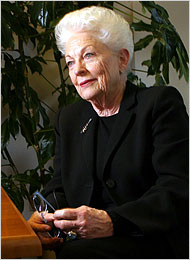
A Lone Star State Progressive

Ann W. Richards died September 13th, at her home in Austin.

Richards, a champion of women’s rights, once told a television audience, “Ginger Rogers did everything Fred Astaire did. She just did it backwards and in high heels.”

This silver-haired Texas activist declared, “... in politics, your enemies can’t hurt you, but your friends can kill you.”

As Texas governor, Richards underestimated her Republican challenger George W. Bush and was upset in 1994. Later, Richards acknowledged that Bush had been much more effective at “staying on message” and made none of the mistakes that her campaign strategists had expected.

A voice for "New Texas" has been silenced.

Wednesday, September 13, 2006

What should I do with all the time on my hands?


Well. Allow about a year and a half for planning, building and photographing. Lay out your 75,000 Lego pieces. Build a Lego Church.

Once completed your Lego Church will be 7 feet by 5 1/2 feet by 30 inches. It will seat one thousand three hundred seventy-two Lego church members. It will have three thousand nine hundred seventy-six windows. It will feature a balcony, a Narthex, stairs to the balcony, restrooms, coat rooms, mosaics, a nave, a baptistry, an altar, a crucifix, a pulpit and an elaborate pipe organ.

Half our life is spent trying to find something to do with the time we have rushed through life trying to save. - Will Rogers

Tuesday, September 12, 2006

Keep an eye on your license plate!


Have you checked your license plate lately? It seems people are stealing the plates to get free gas.

With gas prices soaring, people are putting stolen license plates on their car, filling up at the gas station, and driving off without paying. When the license plate is reported as the "drive off vehicle", guess who gets a visit from law enforcement.

Are your license plates where they are suppose to be?

Monday, September 11, 2006

Remembrance


Blessed are the meek,
For they shall inherit the earth.

One’s spirit accepts God’s dealings with us as good. This meekness before God is a fruit of power. Meekness places the infinite resources of God at one’s command.

Sunday, September 10, 2006

Classroom Inquiry and Teacher Response

"What are we doing today?" After being in the system for years, as a student should realize that this lesson is the activity for the day.

"Why do we have to learn this?" Using vast statistical reviews, educational textbook editors have determined this information to be a basic necessity for your growth.

"When am I ever going to need this in real life?" While skepticism maybe the door post of your adolescent viewpoint, one cannot always anticipate a future need.

"Will this be on the test?" Only if grades are due.

"Can I go to the bathroom?" Of course.

Saturday, September 09, 2006

Let the fun begin.

Welcome back.

As the school doors open, the schoolhouse seems to be little changed. This might be the year to accomplish those things that you previously only dreamed about attempting.

Why not begin by putting some fun in your classroom. Sign up to participate in an Online Project.

Sunday, December 11, 2005

Senator Eugene McCarthy


"There is only one thing to do
- take it to the country!"

Former Sen. Eugene J. McCarthy (D-Minn.), whose surprisingly strong showing in the 1968 New Hampshire presidential primary dramatized deepening public opposition to the Vietnam War and effectively ended President Lyndon B. Johnson's political career, died yesterday Saturday, December 10th. He was 89.

Several years ago I was present at Wells College when Sen. McCarthy read his poetry.

Sitting there in a floral print wingback chair Sen. McCarthy shared his poems with the Wells women and a few men. I recall feeling that I was in the presence of a man who was comfortable in his skin.

While Sen. McCarthy was viewed by peers as something of a ruminator and a curmudgeon. I remember him as a most civil man driven by his conscience.

Robert Kennedy's brother, Senator Edward M. Kennedy of Massachusetts, said in a statement yesterday: "Gene's name will forever be linked with our family. In spite of the rivalry with Bobby in the 1968 campaign, I admired Gene enormously for his courage in challenging a war America never should have fought. His life speaks volumes to us today, as we face a similar critical time for our country."

Sen. McCarthy often proclaimed his dependence on Thomas More as "the first modern man, the first political man."

"He was forced to make a kind of individual and personal choice at a time when there was great upheaval," Mr. McCarthy noted with satisfaction as he tried to explain himself to a nation also in upheaval.

Thursday, December 08, 2005

Wisdom


Maya Angelou


    Maya Angelou was interviewed by Oprah on her 70+ birthday. Oprah asked her what she thought of growing older. And, there on television, she said it was "exciting." Regarding body changes, she said there were many, occurring every day...like her breasts. They seem to be in a race to see which will reach her waist, first. The audience laughed so hard they cried. She is such a simple and honest woman, with so much wisdom in her words!

    Maya Angelou said this:

"I've learned that no matter what happens, or how bad it seems today, life does go on, and it will be better tomorrow."

"I've learned that you can tell a lot about a person by the way he/she handles these three things: a rainy day, lost luggage, and tangled
Christmas tree lights."

"I've learned that regardless of your relationship with your parents, you'll miss them when they're gone from your life."

"I've learned that making a "living" is not the same thing as "making a life."

"I've learned that life sometimes gives you a second chance."

"I've learned that you shouldn't go through life with a catcher's mitt on both hands; you need to be able to throw some things back."

"I've learned that whenever I decide something with an open heart, I usually make the right decision."

"I've learned that even when I have pains, I don't have to be one."

"I've learned that every day you should reach out and touch someone. People love a warm hug, or just a friendly pat on the back."

"I've learned that I still have a lot to learn."

"I've learned that people will forget what you said, people will forget what you did, but people will never forget how you made them feel."

Saturday, November 19, 2005

"Mother, what was war?"


‘... I tell you, war is hell!’


Publishers Weekly describes The March by E.L. Doctorow as “a ... Civil War Canterbury Tales.” In this powerful story, Union General William Tecumseh Sherman is affectionately called "Uncle Billy" by his troops. Nevertheless Sherman's name may still be the answer to the Alex Trebek question, "Who was and still is the most hated and despised man in the history of Georgia?”


Doctorow offers this stunning climactic statement from Sherman's lips: "our civil war . . . is but a war after a war, a war before a war."


Will today's war in Iraq replace the war in the fictitious Sherman's statement? If so, who will history scorn?

Wednesday, October 26, 2005

Sit Still - Just Sit Still


"I got on the bus to go home."

The famous U.P.I. photo
actually taken on Dec. 21, 1956


Robert Fulghum on page 112 of his bestseller, It Was On Fire When I Lay Down On It, quotes the words heard at the pearly gates Monday evening 24th of October 2005. “Ah, Rosa Parks, we’ve been expecting you. Make yourself at home---take any seat in the house.”

Nearly 50 years ago, Dec. 1, 1955, Parks challenged the South's Jim Crow laws -- and Montgomery's segregated bus seating policy -- by refusing to get up and give her seat to a white passenger.

Impressive - how doing nothing could cause so much activity.

Wednesday, July 20, 2005

Flip-flops

"to flip-flop, or not to flip-flop"


Did the President accuse the Senator?


Or did the media attack the incumbent?


Whatever! the campaign is over.

But thanks to the the national championship Northwestern University women's lacrosse team flip-flops made it to the White House.


How were we to know that what may have started in a garage with a tire would morph into a pleasant respite from the war, Hurricane Emily, London bombings, Supreme Court confirmations, and other worldly concerns.

Flip - Hooray! for the one of the most comfortable forms of political footwear.

Flop - One recent study showed more and more problems tied to the casual footwear, citing a 15-percent increase in flip-flop-related injuries, such as back pain, knee problems and numbing of the toes.

Our best bet might be to kick the flip-flop habit off every once in awhile. Limiting how often we use flip-flops might save us years of misery down the road.

Sunday, May 15, 2005

Act Your Age


Acting Their Age


According to David J. Ekerdt, director of the Gerontology Center at the University of Kansas, who coined the term busy ethic in a 1986 paper, there is an expectation that old age should be filled with activity. "Contemplation and inactivity is highly suspect all through life," he said.

Dr. Ekerdt said that when he used to interview retired couples for his research, "The wives would express dismay about their husbands, saying 'He just sits around and reads all day.' " That would hardly seem to be a common complaint now.

Take Jagger and Richards for instance. The Rolling Stones announced plans last week for another world tour. Mick Jagger will be 62 when the tour begins in August, and Keith turns 62 in December. While they may be aging rockers, they are also something else: active seniors.

But it's not just money that drives Mr. Jagger and Mr. Richards - and Charlie Watts, 63, and Ron Wood, the baby of the group at 57 - to keep performing.

"That's what they know how to do," said Nancy Morrow-Howell, a professor of social work at Washington University in St. Louis. "They're going to continue to do it."

So put your iPod earplugs in and crank up "Satisfaction".

Let's hear it for all those 60+ teenagers who know how to do it.

Sunday, April 10, 2005

Fatal Attraction To Sideshows


P. T. Barnum


Tsunami Disaster


Terri Schiavo


John Paul II


Prince Rainier


Has death become a reality show?

Tuesday, March 29, 2005

Kevin Pittsnogle - Mountaineer

Pittsnogle Fever


Pittsnogle, oddly euphonious. Pittsnogle, can you say it without giggling?


Pittsnogle, how many different ways you can use it a sentence?


Pittsnogle, what comes to mind? colorful tattoos? an uneven haircut? a scruffy goatee? a married collegian? a 6-foot-11 junior forward who does not like to play under the basket? a West Virginia player actually from West Virginia?


Have you been Pittsnogled yet?


March Madness. What fun.

Sunday, March 27, 2005

Is B.C. history?

You Say Tomato And I Say…Tomahto


Whether the tomato is fruit or vegetable is almost like the story of which came first, the chicken or the egg.


Now a new debate - should classroom instructors change B.C. to B.C.E. for Before Common Era and A.D. to C.E., for Common Era?


Just maybe Ira had it right, “Let's call the whole thing off.”

Friday, January 21, 2005

What's it all about, Dubya?

In his second inaugural address, President George W. Bush used the word "tyranny" five times, "liberty" 15 and "freedom" 27. What do these words mean to you, Mr. President?

President Bush pledged to reform "great institutions to serve the needs of our time." What “great institutions” do you have in mind, Mr. President?

President Bush stated that "... it is the urgent requirement of our nation's security, and the calling of our time." If “it” is freedom and liberty, how do you plan to spread these ideals, Mr. President?

President Bush promised that U.S. relations with other countries would turn on how decently they treat their own people. How would you define “decently”, Mr. President?

Let intelligent discourse lead the way and you will find your answers, Mr. President.


Alfie


What's it all about, Alfie?
Is it just for the moment we live?
What's it all about when you sort it out, Alfie?
Are we meant to take more than we give
or are we meant to be kind?
And if only fools are kind, Alfie,
then I guess it's wise to be cruel.
And if life belongs only to the strong, Alfie,
what will you lend on an old golden rule?
As sure as I believe there's a heaven above, Alfie,
I know there's something much more,
something even non-believers can believe in.
I believe in love, Alfie.
Without true love we just exist, Alfie.
Until you find the love you've missed you're nothing, Alfie.
When you walk let your heart lead the way
and you'll find love any day, Alfie, Alfie.

Thursday, January 20, 2005

The fellows in the Guinness beer commerical have it right

For the Love of Beer


Sometimes when I reflect on all the beer I drink, I feel ashamed. Then I look into the glass and think about the workers in the brewery and all of their hopes and dreams. If I didn't drink this beer, they might be out of work and their dreams would be shattered. I think, "It is better to drink this beer and let their dreams come true than be selfish and worry about my liver."
Babe Ruth

An intelligent man is sometimes forced to be drunk to spend time with his
fools.
Ernest Hemingway

When I read about the evils of drinking, I gave up reading.
Paul Hornung

24 hours in a day, 24 beers in a case. Coincidence? I think not.
H.L. Mencken

When we drink, we get drunk. When we get drunk, we fall asleep. When we
fall asleep, we commit no sin. When we commit no sin, we go to heaven. So, let's all get drunk and go to heaven!
George Bernard Shaw

Beer is proof that God loves us and wants us to be happy.
Benjamin Franklin

Without question, the greatest invention in the history of mankind is beer. Oh, I grant you that the wheel was also a fine invention, but the wheel does not go nearly as well with pizza.
Dave Barry

Remember "I" before "E", except in Budweiser.
Professor Irwin Corey

To some it's a six-pack, to me it's a "support group." Salvation in a can!
Leo Durocher

Friday, December 17, 2004

Maybe Scrooge Had It Right

Many schools are confused about what to do in December.

Since President George W. Bush’s first run for the Presidency, there has been an emphasis on the faith-based point of view and an intense interest in spirituality. This desire to understand religious traditions and to be in touch with a spiritual core appears to have penetrated the schoolhouse. But with this infiltration deep emotions have been triggered because public schools have been a place where we define ourselves as a people.

With Christmas becoming synonymous with the cash register and not the crèche, some parents have expressed the desire that their offspring be allowed to share some of their childhood memories, such as, a big Christmas tree right in the classroom or the belting out of carols with their classmates.

But what are school administrators to do? Perhaps administrators need to call on the Grinch to help solve their dilemma. Then they can "take the path of least resistance" and ban all holiday celebrations.