Friday, May 15, 2009

Skaneateles Seawall


This photo taken by Al Campanie on May 14, 2009 at 3:27 PM was featured in the High Winds Hit CNY gallery in the Syracuse newspaper - The Post Standard.

In all my years of visiting Skaneateles I do not recall ever seeing the lake crash over the seawall.

Thursday, May 14, 2009

Tulip


Tulip


Tulipa gesneriana


Red Tulip - Declaration of Love


Variegated Tulip - Beautiful You


Yellow Tulip - Hopeless Love


But love, first learned in a lady's eyes,
Lives not alone immured in the brain,
But, with the motion of all elements,
Courses as swift as thought in every power,
And gives to every power a double power,
Above their functions and their offices.
It adds a precious seeing to the eye;
A love's eyes will gaze an eagle blind;
A lover's ears will hear the lowest sund,
When the suspicious head of theft is stopp'd:
Love's feeling is more soft and sensible
Than are the tender horns of cocked snails:
Love's tongue proves dainty Bacchus gross in taste.
For valour, is not love a Hercules,
Still climbing trees in the Hesperides?
Subtle as Sphinx as sweet and musical
As bright Apollo's lute, strung with his hair;
And when Love speaks, the voice of all the gods
Makes heaven drowsy with the harmony.
Never durst poet touch a pen to write
Until his ink were temper'd with Love's sighs.
Love's Labour's Lost William Shakespeare 1564-1616


Its name comes from the Persian word "tulipant" meaning turban which was used to describe the shape of flower. However, it was Holland that took the tulip to its heart. In fact, tulipmania put Holland's economy in jeopardy.

A Persian legend tells of the origin of tulips. A young man, Farhad, was in love with a beautiful woman, Sharin. One day Farhad received news that his lover was dead. In his grief, Farhad jumped off a high cliff and where his body landed, there the tulips first grew. The saddest part was that the message was sent by jealous rival and Sharin was actually still alive.


The tulip grows upright and is regarded as a flower of the sun. It faces into the light and it closes its petals at dusk.

Tulips were first brought to America by the Dutch colonists who settle in the northeastern part of the country. The popularity of these flowers in those communities is obvious from the prevalence of the tulip in Pennsylvania Ducth designs from the period.


Tulips are grown solely for pleasure, having no value for the herbalist. However, the hungry populace of occupied Europe ate them during the war.

"See these cheeky tulips,
how they raise their coloured cups
and demand to sup."
Hafis - Persian poet - 1327-90

Daffodil


Daffodil


Narissus pseudonarissus • Narissus poeticus


Regard and Chivalry


I wandered lonely as a cloud
That floats on high o'er vales and hills,
When all at once I saw a crowd,
A host of golden daffodils;
Beside the lake, beneath the trees,
Fluttering and dancing in the breeze.

Continuous as the stars that shine
And twinkle on the milky way,
They stretched in never-ending line
Along the margin of a bay:
Ten thousand saw I at a glance,
Tossing their heads in sprightly dance.
William Wordsworth 1770-1850


Wordsworth's famous lines have immortalized the Daffodil.


Know in Shakespeare's day as the Lent lily, some regarded the daffodil as unlucky to have in the house for they hang their heads and bring tears and unhappiness.


Traditionally, the first Sunday in April in England was "Daffodil Sunday," and people would pick daffodils from their homes and surrounding fields to take to the hospitals in London.


Superstition in Maine says that if you point your index finger at a daffodil, you will cause it not to bloom.


In the Victorian language of flowers, a daffodil means regard, and the great yellow daffodil is the symbol of chivalry.

Since the Middle Ages in the Christian faith, the daffodil has been viewed as a symbol of Christ's resurrection and the promise of eternal life.


This national emblem of Wales is better enjoyed outside in the garden because its fragrance is so overpowering.

Wednesday, May 13, 2009

Dandelion


Dandelion


Oracle


Some young and saucy dandelions
Stood laughing in the sun;
They were brimming full of happiness
And running o'er with fun.

At length they saw beside them
A dandelion old;
His form was bent and withered,
Gone were his looks gold.

"Oh,oh!" they cried, "just see him;
"Old greybeard, how d'ye do?
We'd hide our heads in the grasses,
If we were as bald as you."

But lo! when dawned the morning,
Up rose each tiny head,
Decked not with golden tresses,
But long grey locks instead.
Anonymous


Every kid loves to blow the seeds from the dandelion seedhead to tell the time.


The name is from the French, "dent-de-lion", because the jagged edges of the leaves are like the teeth of a wild animal.


Several superstitions surround the Dandelion. A wish should come true if all the seeds are blown off in one breath; if some remain it indicates how many children you will have.

Tuesday, May 12, 2009

Hyacinth


Hyacinth


Hyacinthus orientalis


Sorrow


Yet art thou not inglorious in thy fate;
For so Apollo, with unweeting hand
Whilome did slay his dearly-loved mate
Young Hyacinth born on Eurotas' strand,
Young Hyacinth the pride of Spartan land;
But then transform'd him to a purple flower
Alack that so to change thee winter had no power.
John Milton 1608-1674


The hyacinth is native to southern Turkey. But most have been found in early Greek gardens since Homer referred to this fragrant plant as blue as birds' eggs.

When French Huguenots fled to Berlin in 1685, they took hyacinth bulb with them and started a flourishing trade.


With a fragrance that almost narcotic the shape of the hyacinth's flowers is compared to the curly locks of a loved one's head: "sweeter to me than musk is her fragrant hyacinth hair."


Grape Hyacinth

Muscari


Grape hyacinths are native to southern Europe, Northern Africa, and western Asia. Its Greek name means "a bunch of grapes." This, along with the plant's physical resemblance to the hyacinth, gives it the common name, grape hyacinth.

The first-century Greek physician Discorides wrote, "of this wort it is said that it was produced out of dragon's blood, on top of mountains, in thick forests."

Crocus


Crocus


Crocus vernus • Crocus sativus


The golden-yellow crocus as seen here made its way to Europe from the Orient as a highly-prized curiosity and began to be cultivated there in 1597.


Native to the northern shore of the Black Sea, the crocus adds color to lawns and borders at the onset of Spring.


The Bible alludes to the crocus in Solomon's Song of Songs and confessors of the Christian faith in their wisdom were compared to shining crocuses.

Crown Imperial


Crown Imperial


Fritillaria imperialis


Majesty and Power


...bold oxlips, and
The crown-imperial; lilies of all kinds,
The flow'r-de-luce being one. O, these I lakc.
To make you garlands of and my sweet friend
To strew him o'er and o'er.
The Winter's Tale, William Shakespeare 1564-1616


Originating in the Orient, this native to the western Himalayas is considered by some to be the "lilies of the fields" mentioned in the Sermon on the Mount.

According to another legend, the tears of Christ on the Mount of Olives fell into the crown imperial's petals, pressing them down in a sign of mourning.

As its meaning suggests, this majestic flower grows to a great height and looks down on all surrounding flowers. But unlike most of the lily family, it has a most unattractive scent.

Wednesday, April 22, 2009

NYS Marker - Millard Filmore


This morning the Auburn newspaper, The Citizen, featured the photo of a NYS Marker on its front page.

This historical sign marks the birthplace of President Millard Fillmore in Summer Hill.

This entry is for the History Nugget meme on Markeroni.com.

Markeroni, the gentle art of landmark-snarfing is an “informal history” site which provides information about historical markers and landmarks so that you can find them, and a place to log them when you have.

This week’s post - link.

Friday, March 20, 2009

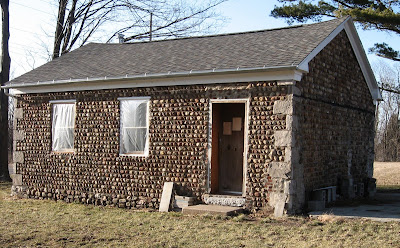
One-room school remembered...


Roe Cobblestone Schoolhouse
South Butler, New York


One-room school remembered...

There were 190,000 one-room schools scattered throughout the American countryside in 1919. Surprisingly, as late as four years ago, there were still almost 400 in existence, most of them in our Western states. Lewis County in Upstate New York had 240 one-room schools in 1875. There are none today and only tumble down relics of these simple buildings still exist at few crossroads in the county. Look carefully and you can discover remnants of others that have been retrofitted to other purposes.

Gone also are the one-room school "marms." These hardy (mostly) women ruled over their tiny kingdoms of learning with no help from a principal or secretary, or doctor or nurse, or remedial expert, school psychologist, music or gym teacher or custodian... They were, in the solitude of their one-room country cross road school, all of these.

Life in a one-room school
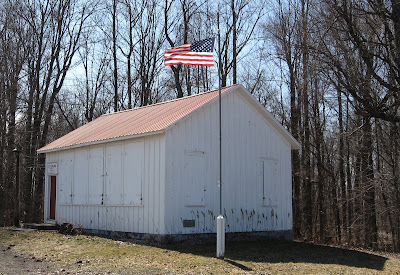


Wiley Schoolhouse
Hogback Road, Savannah


It wasn't unusual for students in a rural one-room school to have the same teacher for many years in a row, a concept referred to as "looping" when it's used in larger schools. And in one-room schools, the older students often helped the younger ones.

These qualities made one-room schools unique centers of learning, sometimes today, worth a second look from a world that has passed them by. But the schools were often more than a place to get an education. They are also important centers of community activity for the rural areas where they existed.

Their days were numbered. Depopulation was one reason for the closure of some one-room schools. Others were lost as states and localities consolidated one-room schools into larger facilities in an effort to save money through "economies of scale."

The teacher was almost always a single lady and had to be a "paragon of virtue." She also had to be a tireless worker with the "patience of Job." First of all, because of the transportation of the time, it was sometimes necessary that she board in the district. One Tug Hill teacher actually moved into her one-room school for the winter. It was not always easy to find a place to stay and when one was found, it usually left "something to be desired." Sometimes, it was with one of those big families and she would have to share a room with one of the younger girls. There was no privacy, so the teacher stayed at the schoolhouse as long as daylight would permit. However, with all her duties, there was always work to be done there. Her typical day went something akin to this: She arose early, dressed for school, ate breakfast, packed her own lunch and walked to school, whatever the distance. Upon arriving, she carried wood and kindling from the woodshed and built the fire. As the building was warming, she carried in the day’s water for drinking and washing hands. The room tidied, lessons for the day reviewed, plans were made and questions, plans and instructions were written on the blackboard.

Time was always too short, as pupils soon began to arrive with things to share, questions to be answered, quarrels to be settled, etc. etc. From 9 a.m. until school was dismissed at 4 p.m., not one moment could she call her own. During the day, she "wore the hats" of superintendent, principal, counselor, teacher, coach, nurse, janitor, referee, baby-sitter and others, Decisions to be made were her own — there was no one to help or advise and no telephone to call for help should she need it. Even during recesses and the noon hour, she was on playground duty. When 4 p.m. came and the last child had left, she drew a sigh of relief, picked up the broom, did the sweeping, checked the buildings and grounds, began her planning for the next day's lessons and on and on.
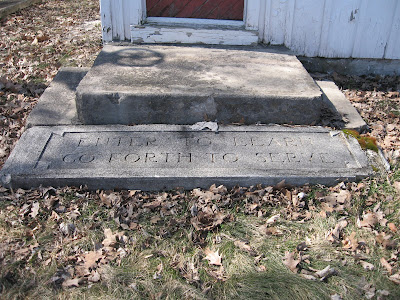


Finally, as the sun was getting low in the sky, she trudged her weary way toward her boarding home, loaded down with a big pile of papers to correct. It took a special kind of person to be a teacher in a one- room rural school. And if she were that special person, she received her reward in the satisfaction and joy of her work. Her pupils loved and respected her — they wanted to help her and to share with her. "An apple for the teacher" was no trite expression. There were apples for the teacher and many other goodies as well. Until a monitor schedule could be set up, the pupils vied with each other over who would clean the erasers, wash the blackboard, raise the flag, ring the bell, etc. Students wanted to learn for her and learn they did in spite of many adverse conditions. Parents, in general, were behind her in her efforts and gave cooperation. Most of them were advocates of the old saying, "If you get a licking at school, you will get another one when you get home." Therefore, seldom was such a punishment needed. Parents taught respect and honor for the teacher. Many a young female student was inspired by her “schoolmarm” to become a teacher in later years.

Source: Gordie Allen - Journal-Republican - Allen’s Alley column 3-20-09

Friday, March 13, 2009

SnoFest Old Forge NY - March 13 & 14, 2009


This event has been on our calendar since we missed last year's festivities. Picked up Emily and Michael in Syracuse around noon and left for Camp Michael. Rte. 81 provided for clear sailing. No noticeable snow until we entered Barnes Corners. There was scattered snow melt at the Maple Ridge Wind Farm viewing station on Eagle Factory Road.


Refueled with subs at Jreck’s. Snow amounts increased at we approached Camp Michael on the Number Four Road. Turning into the driveway at camp we were overwhelmed by the unbelievable height of March's snow.


After lunch we hiked into Francis Lake to check our geocache. To our surprise we met Greg, a Town of Watson employee, who just happened to pick today to locate the cache. We had a pleasant chat with Greg as we made our way back to the Stillwater Road.


Francis Lake Outlet


Team - CameronDouglas & Greg


Francis Lake - view from the cache


Continued up the Stillwater Road to Moshier Dam and Sunday Creek. But heavy snow cover prevented us from hiking to the crossing bridge.

For dinner Michael took us to Timberview Lodge. The spectacular view complemented our excellent meal. Emily recommends the open-face steak sandwich. On Brad's suggestion, I savored a bowl of Mushroom Stew. Michael had the Caesar chicken wrap.

After breakfast with Bill at the Sawmill we traveled over the Moose River road to the pond in Old Forge. Perfect timing - the bus shuttle arrived as we did and ferried us over to the recreation center.

Impeccable timing here too as the Rave X-team was commencing their noon freestyle snowcross show. These daring snowmobile stunts had the crowd in awe.


ESPN X Games gold medalist - Dane Fergason


Member of the RaveX team freestyling.


After the entertainment we signed up to test 2010 snowmobile models provided by Polaris, Arctic Cat, Ski Doo and Yamaha.


"Ride 'em, girl!"


"The Rookie"


"The Pro - BabyJo"


Staging Area


Heading Out


"Deer Beware!"


On our way to the car we caught a glimpse of Judy skiing down McCauley Mountain.


Judy is to the left of the scenic chair lift.


Before stopping at Daiker’s for lunch we drove to Northwoods Inn for a quick photo opt.


Northwoods Inn - same place only the faces have changed


The authentic Adirondack atmosphere of Daiker's gave our chicken wings an added zest. On the deck afterwards the local put on an ice show of their own making.


Ice Racing


Figure Skating


All in all a good road trip.